

Trauma can leave marks that other people can’t see. You might be going about your day when suddenly your heart races, your body freezes, or a wave of fear or shame rushes in. Maybe a sound, a smell, a tone of voice, or even a Bible verse sets something off inside you. These are often trauma triggers, and if this is happening to you, you are not “crazy” or “too sensitive.” Your body is trying to protect you.
Trauma triggers are reminders of past pain that make your brain and body react like the trauma is happening all over again. They can lead to strong reactions, including PTSD flashbacks, panic, or shutting down. In this article, we’ll talk about what trauma triggers are, how they connect to PTSD flashbacks, and simple ways to cope and find support. My goal is to help you understand what’s going on inside you and remind you that healing is possible.
You do not have to walk this alone. With the right tools, kind support, and God’s gentle presence, your nervous system can learn to feel safer again. As you read, notice what feels true for you, and permit yourself to take this in slowly. Your story matters, and so does your healing.
What Are Trauma Triggers and Why Do They Happen?
Trauma triggers are reminders, either inside or outside of you, that pull your body and mind back toward a past traumatic experience. These reminders can be subtle: a smell, a sound, a certain look on someone’s face, or even a familiar sensation in your body. Even if you logically know you’re safe, your nervous system might react as if the traumatic event is happening all over again. This reaction can include physical signs like a racing heartbeat, tense muscles, or shallow breathing.
When people experience trauma, the brain’s “alarm system” stores powerful memories to protect them from future danger. It learns patterns quickly, like associating loud noises or raised voices with threat. Later, when something similar appears, your body may relive fragments of that fear. This doesn’t mean weakness; it’s your body’s survival instinct. The same post-traumatic stress disorder (PTSD) mechanisms that once kept you safe can sometimes fire off when they’re no longer needed.
There’s a big difference between regular stress and a trauma trigger. Normal distress may leave you tired or upset, but a trigger can cause you to feel hijacked, numb, or flooded with intense feelings such as fear, shame, or anger. These reactions can impact relationships, work, and spiritual connection. The hopeful truth is this: the same brain that learned to survive can also learn to rest. With time, care, and sometimes therapy, your body can relearn safety and begin to heal from past trauma.
Common Types of Trauma Triggers and PTSD Flashbacks
Trauma triggers can be external, internal, or tied to relationships and faith. Each person’s triggers are unique, but it often helps to know some common patterns.
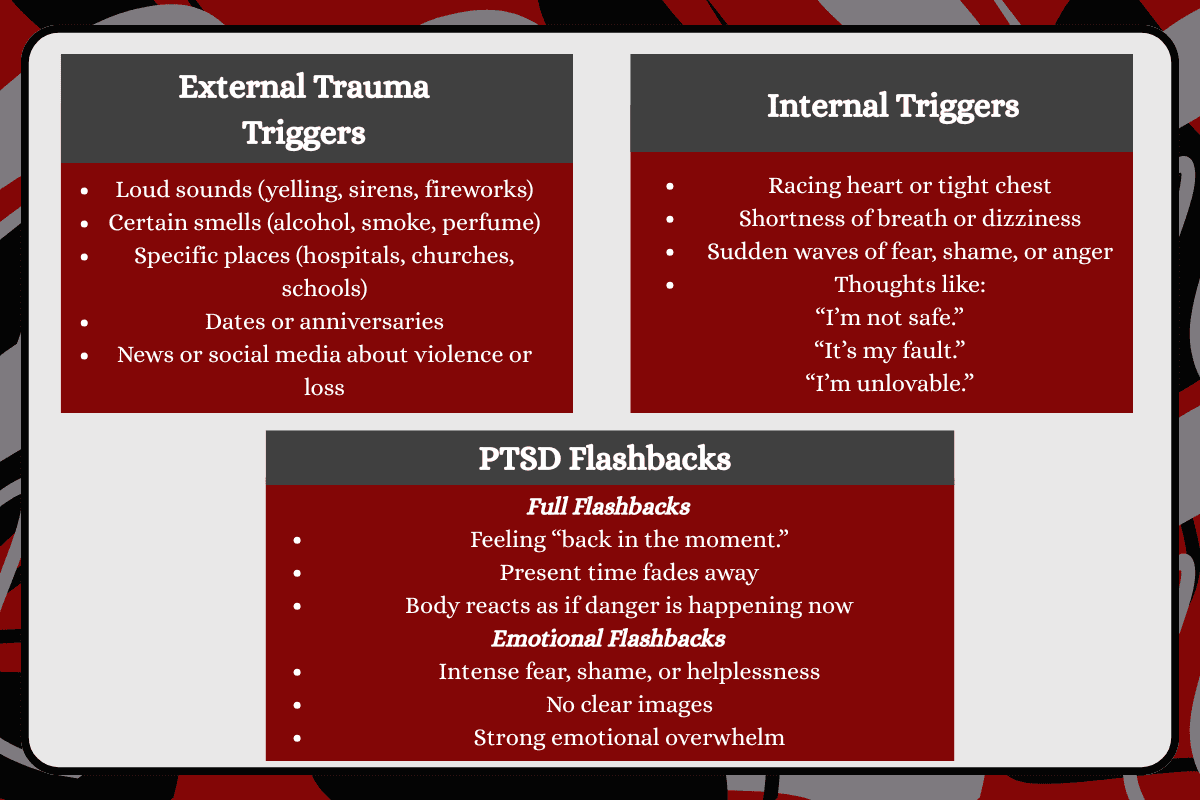
External triggers are things outside of you. These might include:
- Sounds like yelling, sirens, fireworks, or slamming doors
- Smells such as alcohol, smoke, or a certain perfume
- Places like hospitals, churches, schools, or certain neighborhoods
- Dates or anniversaries of painful events
- News stories or social media posts about violence, abuse, disaster, or loss
Internal triggers are things that happen inside your body or mind. For example:
- A racing heart, tight chest, or shortness of breath
- Feeling dizzy, lightheaded, or shaky
- Sudden waves of shame, sadness, or anger
- Thoughts like “I’m not safe,” “I’m unlovable,” or “It’s all my fault”
Sometimes trauma triggers lead to PTSD flashbacks. A flashback is when your body and emotions act like the trauma is happening again. This can look like:
- Full flashbacks, where you feel “back in the moment,” and the present fades away
- Emotional flashbacks, where you are flooded with fear, shame, or helplessness without clear images
How to Cope With Trauma Triggers (In the Moment and Over Time)
When a trigger hits, it often feels sudden and intense. Having simple tools ready can help your body remember that you are in the present, not the past.
In-the-moment coping tools:
- Grounding with your senses:
Look around and name 5 things you can see, 4 things you can feel, 3 things you can hear, 2 things you can smell, and 1 thing you can taste (or remember). This helps your brain reconnect with the here and now. - Feel your feet:
Place your feet flat on the floor. Press down gently and notice the support underneath you. You can silently say, “Right now, in this moment, I am here.” - Slow breathing:
Try inhaling through your nose for a count of 4, holding for 4, and exhaling slowly through your mouth for 6. Repeat several times. Slow exhale tells your nervous system, “We are safe enough to calm down.” - Gentle self-talk:
Phrases like, “This is a trauma trigger. It feels like then, but it is now,” or “I am safe enough in this moment,” can help separate past from present.
Faith-based coping woven in:
If faith is part of your life, you can pair grounding with simple spiritual practices:
- A short breath prayer, like “Lord, be near” or “God, hold me,” as you inhale and exhale.
- Repeating a gentle verse about comfort or refuge, such as “God is our refuge and strength, an ever-present help in trouble.”
- Imagine God sitting beside you, steady and kind, not angry or disappointed.
You also have long-term options to help your nervous system heal over time:
- Trauma-informed therapy can help you understand your trauma triggers, process painful memories at a safe pace, and learn new coping skills.
- Approaches like CBT (working with thoughts), trauma-focused therapy, EMDR-style work, or somatic/body-based therapies can help your brain and body feel safer.
- Tracking your triggers in a simple journal, what happened, how you felt, and what helped, can give you insight over time.
Healing is not about “never getting triggered again.” It’s about feeling less overwhelmed, recovering faster, and slowly expanding your sense of safety.
When to Seek Professional Help for Trauma Triggers
It may be time to reach out for extra support if your trauma triggers are:
- Making it hard to work, study, parent, or care for yourself
- Affecting your relationships in a big way
- Leading you to avoid almost everything that feels hard or uncertain
- Connected to self-harm, substance use, or thoughts of not wanting to live
If you notice these signs, you deserve more than just “pushing through.” You deserve care.
In therapy, the focus should be on safety first. A trauma-informed therapist will not force you to share every detail right away. Together, you can build coping tools, slow down your nervous system, and explore your story in a way that honors your boundaries. If faith is important to you, you may want a therapist who respects your beliefs and doesn’t use them against you.
Reaching out for help is not a sign of failure. It is an act of courage and wisdom. You are choosing not to fight this battle alone.
Final Thoughts
If you see yourself in these words, I want you to hear this clearly: you are not broken, and you are not alone. Trauma triggers are a normal response to experiences that were not normal, safe, or fair. Your body has been trying to protect you the best way it knows how.
With time, support, and God’s gentle grace, your nervous system can learn new ways to feel safe. You can move from just surviving to slowly living with more peace and freedom. For today, you don’t have to fix everything. Maybe your next step is simply naming one trauma trigger, practicing one grounding tool, or talking to one trusted person about what you’re going through.
You don’t have to carry this by yourself. Help is available, healing is possible, and your story is worth staying for.
Blessings,