A panic attack can be frightening, especially when it seems to come out of nowhere. Your heart may race, your breathing may change, or you may suddenly feel dizzy, shaky, or overwhelmed with fear. When these experiences happen repeatedly, it is understandable to start wondering what is happening and whether another attack could happen at any moment.
Panic Disorder is a mental health condition that involves repeated, unexpected panic attacks along with ongoing worry about having another attack or changes in behavior because of that fear. A panic attack is a sudden wave of intense fear or discomfort that can cause strong physical and emotional symptoms. Over time, fear of another attack may lead someone to avoid certain places, activities, or situations, making Panic Disorder about more than the attacks themselves.
Living with Panic Disorder can make your own body feel unpredictable. You may begin watching every heartbeat, feeling, or change in your breathing for signs that something is wrong. But Panic Disorder is treatable. Learning what is happening in your body and mind can be an important first step toward feeling safer and more confident again.
What Is Panic Disorder?
Panic Disorder is an anxiety disorder involving recurring and unexpected panic attacks. These attacks involve sudden periods of intense fear or discomfort, sometimes without an obvious danger or trigger. Not everyone who experiences a panic attack develops panic disorder.
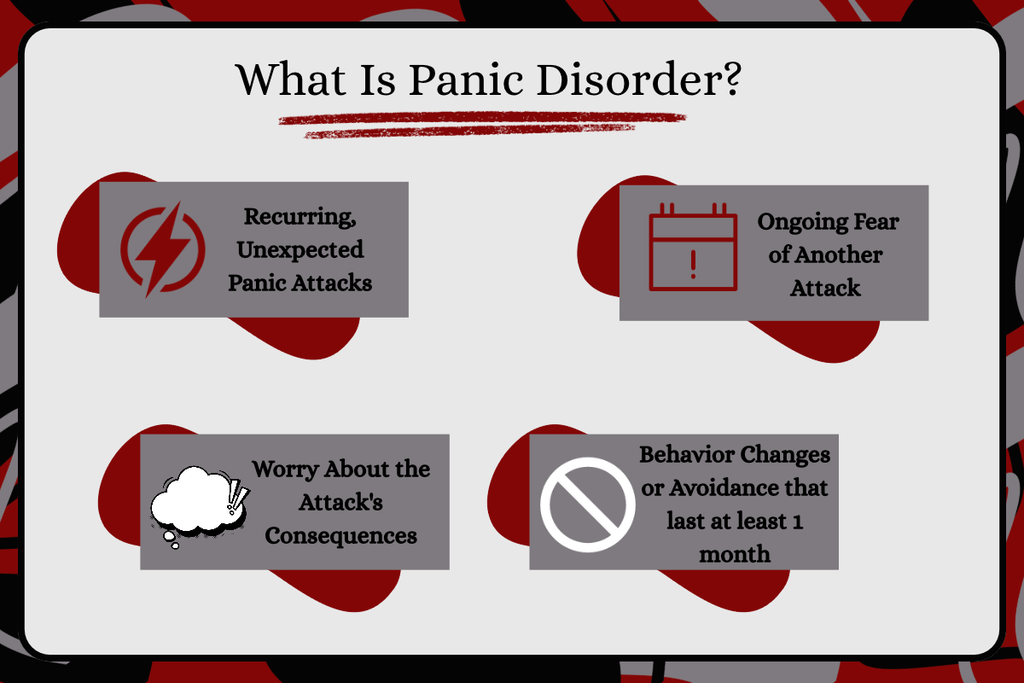
What often separates Panic Disorder from an occasional panic attack is what happens after the attack.
You may start thinking:
“What if it happens again?”
“What if I can’t get away?”
“What if something is seriously wrong with me?”
“What if I lose control in front of other people?”
That fear can become a problem of its own. You may begin monitoring your body, changing your routine, or avoiding situations where you believe another panic attack could happen.
For a diagnosis of Panic Disorder, a mental health professional looks for recurrent unexpected panic attacks along with persistent concern about additional attacks, worries about their consequences, or significant behavior changes related to them. According to the National Institute of Mental Health, these concerns or behavior changes typically continue for at least one month.
In other words, Panic Disorder is not simply about feeling anxious. It can create a cycle in which a person becomes afraid of fear itself.
What Is a Panic Attack?
A panic attack is a sudden surge of intense fear or discomfort. It can happen when you are stressed, but it may also occur when there seems to be no obvious reason to feel afraid.
During a panic attack, the body’s alarm system becomes highly activated. Your brain and nervous system respond as though you need to protect yourself from danger, even when there may be no immediate threat.
Common experiences during a panic attack can include:
- A pounding or racing heart
- Shortness of breath
- Sweating or chills
- Trembling or shaking
- Dizziness or weakness
- Chest discomfort
- Nausea or stomach discomfort
- Tingling or numbness
- Feeling out of control
- Fear that something terrible is about to happen
These sensations can feel extremely convincing. Someone experiencing a panic attack may genuinely believe they are having a heart attack, fainting, dying, or losing control.
That does not mean the person is being dramatic. Their nervous system is producing a very real physical response.
Panic Attack vs. Panic Disorder: What Is the Difference?
A panic attack is an episode. Panic Disorder is a mental health condition involving a recurring pattern.
A person can have a panic attack once or occasionally without having Panic Disorder. Panic attacks can also occur alongside other anxiety disorders and mental health conditions.
With Panic Disorder, however, unexpected attacks are followed by ongoing concern or changes in behavior. The person may become deeply focused on preventing the next attack.
For example, imagine someone experiences a panic attack while shopping.
At first, it may seem like one frightening event. But afterward, they begin worrying that another attack will happen at the store. They start shopping only when someone can come with them. Eventually, they stop going altogether.
The original panic attack has ended, but the fear of another attack begins shaping daily life.
That is an important part of understanding Panic Disorder.
What Causes Panic Disorder?
There is no single known cause of Panic Disorder.
Researchers believe biological processes involved in fear and anxiety may play a role. Panic Disorder can also run in families, although having a family member with the condition does not mean you will automatically develop it. Stress and environmental factors may contribute as well.
For some people, long periods of stress may make the nervous system feel more sensitive. Other people may become especially concerned about physical sensations such as a racing heart, dizziness, or changes in breathing.
This can create what is sometimes called a fear-of-fear cycle.
Understanding the Panic Cycle
One reason panic can grow so quickly is that the body’s normal stress response can become frightening itself.
Imagine noticing that your heart is beating faster than usual.
You might think:
“Why is my heart doing that?”
Then:
“Something must be wrong.”
Then:
“What if I’m having a heart attack?”
That frightening interpretation increases anxiety. More anxiety releases more stress hormones. Your heart beats faster, breathing changes, and you notice even more sensations.
The cycle may look like this:
Body sensation → frightening thought → increased anxiety → stronger body sensations → greater fear
Before long, what began as a small sensation can feel overwhelming.
The National Institute of Mental Health describes panic attacks as potentially functioning like a “false alarm,” in which the body’s normal survival response becomes activated too strongly or at the wrong time.
Understanding this does not instantly stop panic. But it can help you recognize that frightening sensations do not always mean something dangerous is happening.
Panic Disorder and Agoraphobia
Some people with Panic Disorder also develop agoraphobia.
Agoraphobia involves intense fear or anxiety about situations where escaping might feel difficult or where help may seem unavailable if panic-like symptoms occur.
Someone might become afraid of:
- Crowded stores
- Public transportation
- Driving
- Open spaces
- Enclosed spaces
- Being far from home
- Standing in lines
- Being outside the home alone
Panic Disorder and agoraphobia are separate conditions, but they can occur together.
For example, someone who had a severe panic attack while driving might start worrying about having another one while trapped in traffic. At first, they avoid highways. Later, they avoid driving alone. Eventually, even short trips may begin to feel unsafe.
The avoidance makes sense when viewed through the person’s fear. They are trying to protect themselves.
Unfortunately, repeated avoidance can also strengthen the belief that the situation is dangerous.
How Panic Disorder Can Affect Daily Life
Panic Disorder can affect much more than the few minutes in which a panic attack occurs.
For some people, much of the distress happens between attacks.
You may spend time wondering when the next one will happen. You might become highly aware of your heartbeat, breathing, dizziness, temperature, or other sensations in your body.
Activities that increase your heart rate, such as exercise, may begin to feel threatening because the sensations remind you of panic.
Over time, Panic Disorder may affect:
- Work or school
- Driving and travel
- Shopping
- Exercise
- Social activities
- Relationships
- Sleep
- Independence
- Willingness to leave home
Your world can gradually become smaller, not because you no longer want to do these things, but because you are trying to prevent another frightening experience.
This is one reason getting support can be so important.
How Is Panic Disorder Diagnosed?
There is no single blood test or scan that diagnoses Panic Disorder.
A mental health professional or other qualified health care provider will usually ask about your panic attacks, when they started, how often they happen, what you experience during them, and what has changed in your life because of them.
They may also ask how much time you spend worrying about future attacks.
Because symptoms such as chest discomfort, rapid heartbeat, dizziness, and breathing changes can also have physical causes, a medical evaluation may sometimes be appropriate. NIMH notes that clinicians may conduct a physical examination or evaluate other possible causes before confirming Panic Disorder.
This distinction matters.
If you develop new, severe, or unexplained chest pain, difficulty breathing, fainting, or other concerning physical symptoms, do not automatically assume it is panic. Seek appropriate medical care, especially if you are uncertain about what is causing the symptoms.
Can Panic Disorder Be Treated?
Yes. Panic Disorder is treatable, and people can learn to respond differently to the sensations and thoughts that once triggered intense fear.
Treatment often includes psychotherapy, medication, or a combination of approaches depending on the person’s needs. Cognitive behavioral therapy, commonly called CBT, is a well-studied treatment for Panic Disorder. Exposure-based approaches may also help people become less fearful of bodily sensations and situations they have been avoiding.
Treatment is not simply about making every uncomfortable sensation disappear. A major goal is often helping you learn:
“I can feel this sensation without assuming something terrible is about to happen.”
That change can weaken the panic cycle over time.
If you want to understand these approaches more fully, our guide to Panic Disorder Treatment explores therapy, coping skills, medication, exposure-based approaches, and faith-based support in greater detail.
Faith and Panic Disorder: Does Panic Mean Your Faith Is Weak?
If you are a person of faith, Panic Disorder can sometimes bring an additional layer of confusion.
You may wonder:
“Why am I so afraid if I trust God?”
You may even feel guilty for experiencing anxiety.
But experiencing panic does not automatically mean that your faith is weak.
Your nervous system can enter an alarm state even when your spiritual beliefs remain deeply important to you. Mental and physical health struggles are not reliable measurements of someone’s faith.
Scripture repeatedly acknowledges human fear while also reminding us that we do not face it alone.
Isaiah 41:10 begins with the reassurance, “Do not fear, for I am with you.” The message is not that faithful people will never experience fear. Instead, it points toward God’s presence within fearful moments.
Prayer, Scripture, supportive Christian relationships, and time with God may provide comfort and grounding. At the same time, faith-based support does not have to replace professional mental health care.
Seeking therapy can be an act of wisdom and stewardship.
You can pray and talk with a counselor.
You can trust God and learn how your nervous system works.
You can have faith and need help.
These things do not have to compete with one another.
What Can You Do When Panic Starts?
When panic rises, the natural response is often to fight it, escape it, or desperately try to make it disappear.
Sometimes that struggle can make panic feel even more threatening.
Instead, it may help to gently recognize what is happening:
“My body is having a strong anxiety response. This feels frightening, but I can respond one moment at a time.”
You might bring your attention to your surroundings, slow your breathing, relax areas of tension in your body, or notice what you can see, hear, and feel around you.
If you already know that what you are experiencing is panic and you are physically safe, try not to judge yourself for it.
You do not have to solve the entire problem in that moment. Your task can simply be to stay present and allow the wave of anxiety to come down.
When Should You Seek Help for Panic Disorder?
An occasional experience of anxiety does not necessarily mean you have Panic Disorder.
However, consider talking with a mental health professional if panic attacks are happening repeatedly or if fear of another attack is beginning to control your decisions.
Support may be especially helpful when:
- You regularly worry about another panic attack.
- You avoid places because you fear panicking there.
- You have stopped driving, traveling, exercising, shopping, or socializing because of fear.
- You constantly monitor your body for signs of panic.
- Anxiety is affecting work, relationships, sleep, or daily responsibilities.
- Your world feels like it is becoming smaller because of avoidance.
You do not need to wait until Panic Disorder controls every part of your life before asking for help.
Learning what is happening and getting the right support can interrupt the cycle earlier.
Final Thoughts
Panic Disorder can make ordinary sensations feel dangerous and ordinary situations feel unpredictable. But the fear surrounding panic can be understood. With appropriate care, you can learn how your nervous system responds to anxiety, challenge frightening interpretations of bodily sensations, reduce avoidance, and slowly rebuild confidence in the parts of life panic has interrupted.
Healing does not require choosing between emotional care and spiritual faith. Therapy, medical guidance when needed, supportive relationships, prayer, Scripture, and your relationship with God can each have a place in the journey. You do not have to conquer every fear at once. Sometimes the next faithful step is simply deciding that fear no longer gets to make every decision for you.
Blessings,